
A practical guide for Australian ecommerce brands

Choose a Google Ads agency for ecommerce by checking its retail experience, approach to profitability, product feed expertise, conversion tracking, Performance Max strategy and account ownership terms. Ask every shortlisted agency for the same evidence and a written first 90 days plan before comparing fees.
For Australian ecommerce brands, a good agency decision starts with a commercial question: can this team explain how your advertising budget will turn into sales your business can afford to acquire?
A strong pitch should connect campaigns to product margins, stock availability and repeat purchases. It should also make clear who does the work, what you pay for and how you will judge progress. This guide gives you the questions, examples and comparison framework to make that decision.
Start with profitability before discussing ROAS
Return on ad spend (ROAS) is attributed revenue divided by ad spend. It is useful, but it does not tell you how much money remains after fulfilling an order.
Consider two hypothetical product ranges. Each generates A$40,000 in attributed revenue from A$10,000 in ad spend. Both report 4× ROAS. Their contribution margins before advertising are different.
|
Measure |
Range A |
Range B |
|
Attributed revenue |
A$40,000 |
A$40,000 |
|
Ad spend |
A$10,000 |
A$10,000 |
|
Reported ROAS |
4× |
4× |
|
Contribution margin before ads |
40% |
20% |
|
Contribution before ads |
A$16,000 |
A$8,000 |
|
Contribution after ads |
A$6,000 |
−A$2,000 |
Illustrative calculation, not a SEOMAX client result. Revenue and costs use a consistent ex-GST basis. Contribution margin here deducts product costs, payment fees, fulfilment, shipping subsidies and an allowance for returns. The final row excludes agency fees and fixed overheads; it is not net profit.
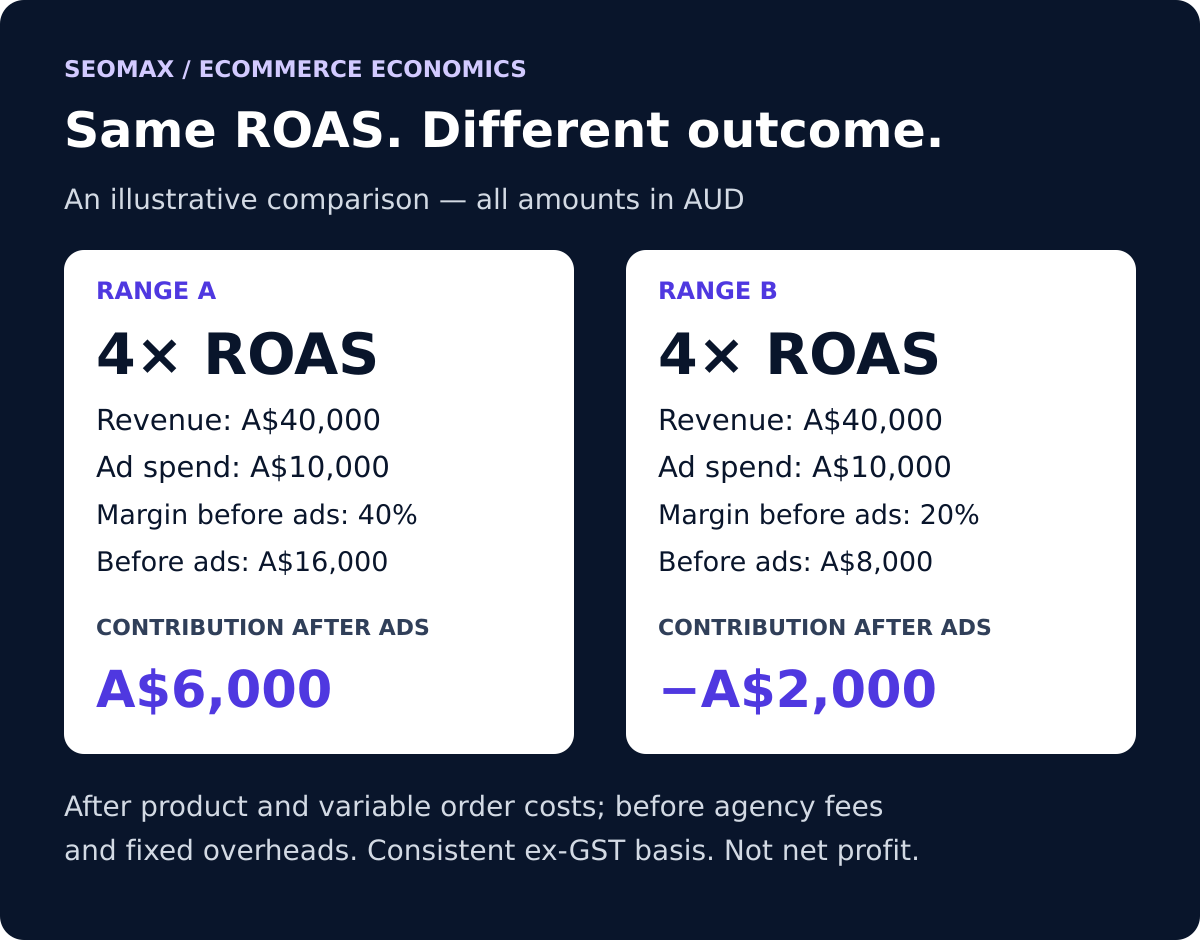
The same reported ROAS can leave very different amounts available to cover agency fees, overheads and profit.
In this simplified model, break-even ROAS before agency fees and overheads equals 1 divided by the contribution margin expressed as a decimal. Range A breaks even at 2.5×; Range B needs 5×. Your operating target needs room for the other costs and profit you want to retain.
Ask an agency which products it would prioritise, what customer acquisition cost your first order can support and when repeat purchases could justify a higher acquisition cost. If it relies on customer lifetime value, ask for observed repeat-purchase data and a payback period your cash flow can support.
Seven checks before you hire an ecommerce Google Ads agency
1. Look for experience with stores like yours
Relevant experience means more than an ecommerce logo on a slide. A retailer with 5,000 products, thin margins and frequent stock changes needs different decisions from a direct-to-consumer (DTC) brand selling a small range with repeat-purchase potential.
Ask for a case study with the starting position, monthly ad spend, product category, timeframe and work completed. Then ask how much of the reported result came from existing brand demand, returning customers or a major sale. An anonymised example can be useful if the agency can still explain its decisions and measurement clearly.
For Australian stores, test how the team plans around Black Friday, Boxing Day, EOFY, delivery cut-offs and stock constraints. A credible answer should connect the promotional calendar to margin and fulfilment capacity.
2. Ask who owns product feed quality
Google Shopping performance depends partly on the information supplied about your products. Incorrect prices, availability, identifiers or variants can create eligibility and display problems. Google's Merchant Center product data specification explains the requirements.
Ask who checks Merchant Center issues, fixes disapprovals and keeps the feed aligned with the store. Request examples of improvements to product titles, images, identifiers and variant data. The agency should also explain whether custom labels for margin, seasonality or stock depth would help organise your catalogue.
A useful answer assigns responsibilities across the agency, feed tool and developer. It also explains how urgent pricing or availability problems are handled between monthly reports.
3. Test the depth of its Performance Max strategy
Performance Max can serve across Google's advertising inventory, including Search, YouTube, Display, Discover, Gmail and Maps. Google combines your goals, product data, creative assets and settings with automated bidding and delivery. See Google's Performance Max overview.
When comparing Performance Max agencies, ask them to explain:
Why they recommend Performance Max, Standard Shopping or a combination alongside Search.
How product economics and available conversion data shape campaign structure.
How they review branded demand, brand exclusions and negative keywords where appropriate.
Who produces and reviews images, video and other creative assets.
How they decide which landing pages may receive traffic.
What evidence would lead them to change the strategy.
A thoughtful agency can discuss both automation and the decisions it remains responsible for. It should explain how it will assess new customer growth, while recognising that platform attribution alone does not prove a sale would otherwise have been lost.
4. Verify purchase tracking before increasing spend
Ask for a measurement audit before a major budget increase. It should check purchase values, currency, transaction IDs, primary conversion actions and whether the same purchase is being used more than once for bidding through separate tracking setups.
Google documents how unique transaction IDs help prevent duplicate conversions for the same conversion action. That does not remove the need to review overlapping conversion actions.
The agency should assess enhanced conversions, which supplement measurement with hashed first-party customer data, where appropriate for your setup and consent requirements.
Ask how Google Ads, GA4 and your store's order records will be reconciled. They may differ because of attribution rules, reporting dates and other measurement settings. A good explanation identifies those differences, checks refunds and cancellations, and separates platform-attributed revenue from total store revenue.
5. Check how paid search fits your wider marketing
A useful multichannel campaign strategy sets a clear role for Google Ads, Meta, organic search and email or SMS. For DTC brand marketing, it should connect acquisition activity with the experience after the first purchase.
Ask who coordinates promotions, creative, product availability and customer exclusions across teams. Also ask how they avoid adding together revenue claimed by several platforms and presenting it as total business growth.
Your Google Ads agency does not need to deliver every service itself. It does need a workable relationship with whoever manages your store, retention and ecommerce SEO. For Shopify stores, the product page and checkout experience also belongs in the discussion when paid traffic is failing to convert.
6. Require account access and useful reporting
Your business should retain administrative control of Google Ads, Merchant Center, GA4 and any relevant tracking container. Ask the agency to work through appropriate access permissions and confirm what happens to campaign history, creative and reporting if the relationship ends.
Request a sample monthly report. It should show spend, purchases, revenue, ROAS and acquisition cost, alongside an explanation of what changed. Where reliable data is available, include new versus returning customers and results by product group.
The report should end with decisions: what to fix, what to test, what to reduce and what would justify additional spend. You should be able to trace the headline figures back to the underlying accounts.
7. Meet the person who will manage the account
Before signing, meet the day-to-day specialist and ask how much responsibility they will carry. Clarify who handles strategy, feed work, tracking and creative, including any subcontractors.
Agree on meeting frequency, response expectations, urgent issue handling and who can approve budget changes. An agency that fits your stage of growth should be able to work at the pace your internal team can support.
Compare Google Ads agencies for ecommerce with this scorecard
Use the same criteria for every proposal. Score each area from 0 to 5: 0 means no evidence, 1 means a vague claim, 3 means a credible explanation with an example, and 5 means relevant evidence plus a clear plan for your store. Use 2 and 4 for answers between those levels.
|
Criterion |
Weight |
Evidence to request |
|
Profitability and commercial fit |
20 |
Margin-based targets and acquisition economics |
|
Tracking and measurement |
20 |
Audit scope and reconciliation example |
|
Shopping and product feeds |
15 |
Feed improvement example and named owner |
|
Performance Max strategy |
15 |
Structure, controls and testing rationale |
|
Relevant ecommerce experience |
10 |
Comparable case study with context |
|
Reporting and account ownership |
10 |
Sample report and written access terms |
|
Team and multichannel coordination |
10 |
Named specialist and responsibility split |
Calculate each weighted result as score ÷ 5 × weight, then add the results for a total out of 100. These weights are a suggested decision aid, not an industry benchmark or a prediction of performance. Adjust them to reflect your store's needs.
Treat missing account access, unclear billing or an unwillingness to explain measurement as issues to resolve before signing, regardless of the total score.
Compare agency fees alongside the scope
There is no useful single price without knowing the work involved. A small catalogue with reliable tracking requires a different scope from a store with several markets, feed problems and ongoing video production.
|
Fee model |
What to clarify |
|
Fixed monthly fee |
Included work, workload limits and when the fee can change |
|
Percentage of ad spend |
Rate, minimum fee and who authorises budget increases |
|
Base fee plus percentage |
Total cost at your current and planned budgets |
|
Performance-linked fee |
Revenue definition, refunds, attribution and treatment of existing demand |
Ask for an itemised proposal separating media spend, management, setup, feed software, creative and development. Confirm the currency, GST treatment, minimum term, notice period and handover arrangements.
For example, A$10,000 in media, A$1,500 in management and A$500 in tools or creative creates a total monthly outlay of A$12,000, assuming a consistent ex-GST basis. This is a budgeting example, not a market-rate estimate. Compare the agency's expected contribution against the full cost you will incur.
Agree on a practical first 90 days plan
Ask each agency to turn its pitch into a sequenced plan with owners and deliverables. This is an example to adapt, not a promise that every account will be ready to scale in three months.
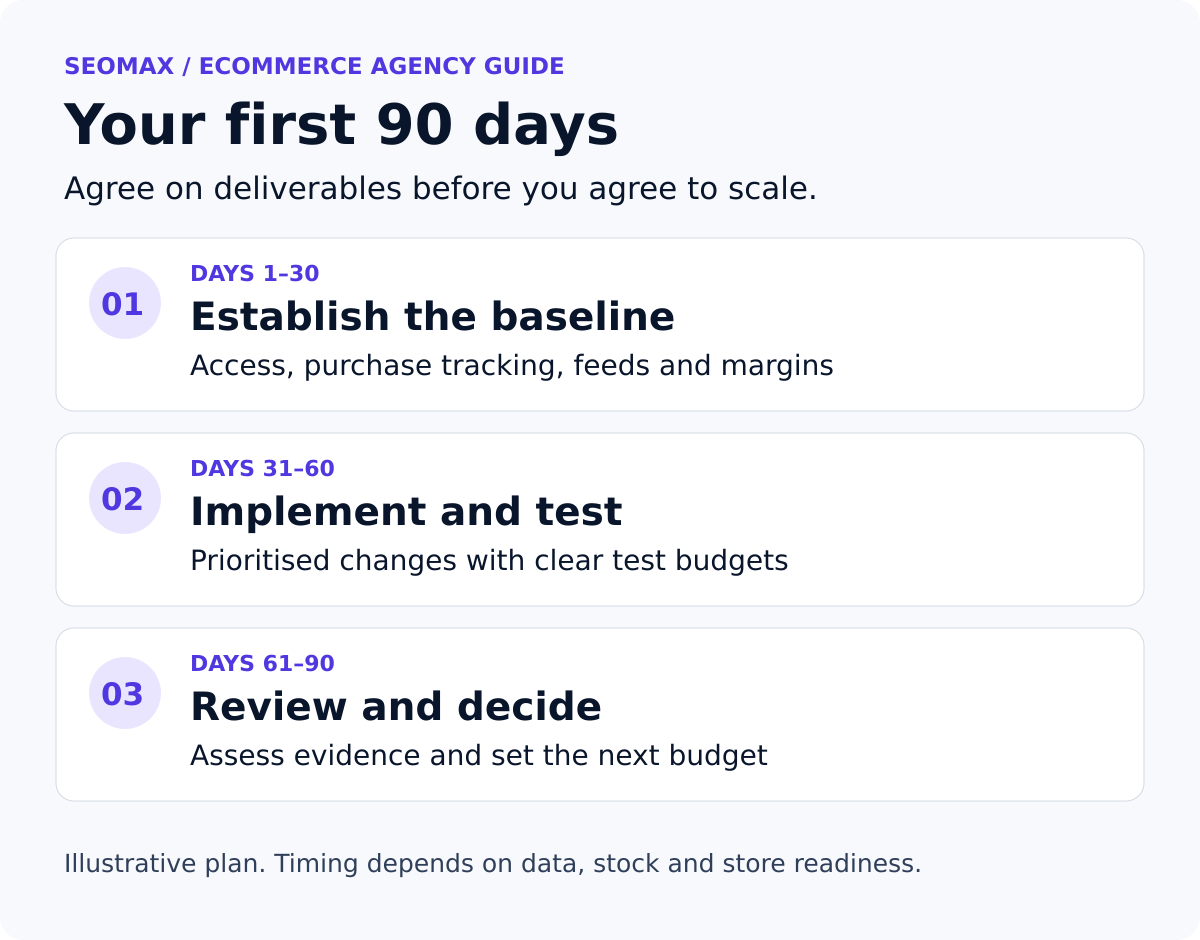
Example onboarding sequence. Scaling depends on reliable measurement, sufficient evidence, margins and stock.
Days 1 to 30 establish a trustworthy baseline
Confirm access, review account history and test purchase tracking. Assess Merchant Center, product economics, stock and landing pages. Agree on reporting definitions and deliver a prioritised plan. Fix urgent problems while preserving useful campaign history.
Days 31 to 60 implement and test priority changes
Improve feeds, campaign structure and creative where the audit supports changes. Document each test, its budget and the decision it is intended to inform. Avoid changing everything at once when that would make the outcome difficult to interpret.
Days 61 to 90 review evidence and set the next budget
Assess performance after allowing for the account's conversion delay. Review contribution, acquisition cost and customer mix where measurable. Expand activity that meets agreed criteria, reduce waste and document unresolved questions. Sometimes the right next step is fixing the store or collecting more data.
Questions to bring to your shortlist calls
Send these questions in advance so you can compare considered answers:
Which products would you prioritise, and what information do you need to decide?
What would you check before trusting our current ROAS?
Who will fix feed problems and validate purchase tracking?
Why does your proposed campaign structure suit our budget and catalogue?
How will you assess brand demand and new customer acquisition?
What work will our internal team need to complete?
What exactly is included in the fee, and what costs extra?
What will we receive in the first 30, 60 and 90 days?
What evidence would make you recommend reducing spend?
What do we keep, and what happens, if we leave?
Be cautious if an agency guarantees a ROAS before reviewing your margins and tracking, shows revenue screenshots without spend or context, hides account access, or proposes a large budget increase without explaining how it will be evaluated.
Frequently asked questions
What makes a good Google Ads agency for ecommerce
Look for relevant retail experience, reliable purchase measurement, feed expertise and a campaign strategy tied to your economics. You should also have a named specialist, clear reporting, transparent fees and control of your accounts.
Should I choose a specialist or a full-service agency
Choose based on the work you need and the team you already have. A specialist can fit a business with strong in-house creative and retention teams. A broader agency may suit a store that needs coordinated execution. Check who actually delivers each service.
Is a Google Partner badge enough to choose an agency
Use a badge as one check in your evaluation. Ask for relevant work, meet the specialist and assess the proposal against your margins, catalogue and goals. A badge alone cannot show whether the working relationship or commercial plan suits your store.
How much ad spend do I need before hiring an agency
Ask whether the budget can support management costs and enough meaningful purchase data for the proposed strategy. The answer depends on acquisition costs, order value and your store's conversion performance. Request the assumptions behind any minimum budget.
How long should I give a new agency to show results
Agree on early deliverables and a review schedule. Tracking repairs and feed fixes can be assessed before commercial trends are clear. The time needed to judge sales performance depends on conversion volume, purchase delay, seasonality and the changes made. Use the first 90 days as a review framework.
Who should own the Google Ads account
Your business should retain administrative control. Give the agency the access it needs and agree on handover terms before work begins, including campaign history, reporting and creative assets.
Discuss your ecommerce Google Ads priorities with SEOMAX
SEOMAX works with Australian online stores on Google Ads management, ecommerce SEO and Shopify growth. You can explore our Google Ads management services or bring your store URL, current spend and main growth challenge to a conversation about the next step.
Book a free strategy call with SEOMAX